
Review by Phil Isherwood
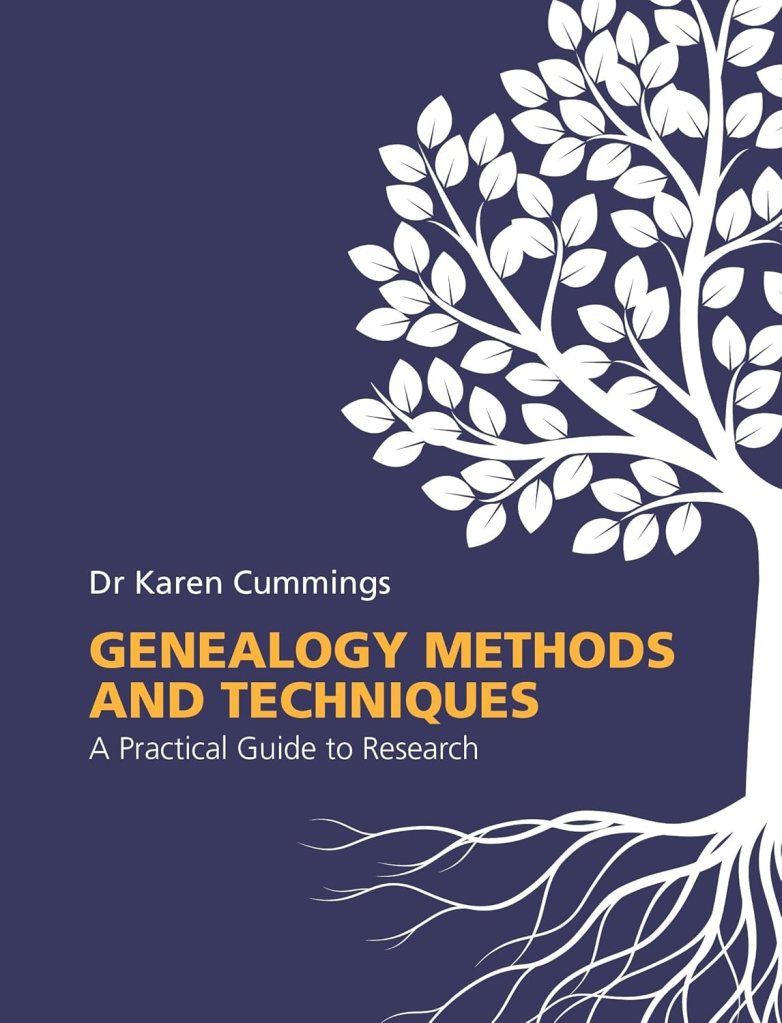
Books on genealogical methods and techniques are few and far between – too few and far between. Genealogy Methods and Techniques by Dr Karen Cummings is a significant contribution to an undervalued field.
A few years ago I wrote a blog article called Four Genealogy Books That Will Improve Your Research. In it I summarized what I felt were the best available books on genealogy methods and techniques at that time. I’m delighted to say there is now a fifth book to join that group – a new standard text that joins the leaders and quietly rearranges them.
Dr Karen Cummings is well known in British genealogy circles as a professional genealogist and educator, especially through Pharos Tutors, the family history training company she owns and runs.
I first met Karen at RootsTech London in 2019, when I recall us having an impassioned conversation about the need for more writing and teaching about genealogical methods in Britain. Karen was in the process of taking over Pharos from her predecessor Helen Osborn (another author in my top five methodology books), and assured me that she agreed wholeheartedly. This book is the proof of that passion.
Structured around eleven chapters covering the foundations, getting organized, evaluating evidence, documenting your research, search techniques, research planning, standards and DNA, Karen approaches each subject with clarity and simplicity. Each chapter is well laid out and illustrated, supported by two high quality and well-documented case studies. The prose is unfussy and readable, leading the reader through each section in logical steps.
Throughout, Karen brings her seasoned educator’s eye to an audience she knows and understands well. While the book is aimed mainly at intermediate-level family historians wanting to take the next step, there is much here for beginners seeking to set off on the right foot, and for seasoned practitioners wishing to elevate their work to professional standards. Genealogy Methods and Techniques has something to offer for all.
The stand-out lesson in the book is, in my view, the degree of detail Karen brings to documenting her research, which she demonstrates very well in the case studies. The heart of this is to document sufficiently, avoiding too much or too little detail. Explaining the evidence and reasoning behind genealogical conclusions is an area where many family historians fall short and can improve. Karen lays out a practical template for how to do that.
At 176 pages the book isn’t overlong, nor does any single chapter outstay its welcome. Karen has brought a plain-English, straightforward approach to a subject that can seem daunting and off-putting. Where some could get distracted by complexity or take a heavy-handed approach, Karen consistently delivers pragmatism over dogmatism.
This is a book that students of genealogy everywhere, but especially in the UK, will be studying for years to come. Expect this to become a set text in many future courses.
If you are looking for a skeleton key to unlock those stubborn “brick wall” cases, a better lantern in the record office or a compass in the genealogical fog, Karen Cummings’ Genealogy Methods and Techniques is for you.
My thanks to Harriet Hurley of Crowood Press for sending me a pre-publication edition of the book.
 Seeing the Wood for the Trees